If you have a hernia, you have a choice.
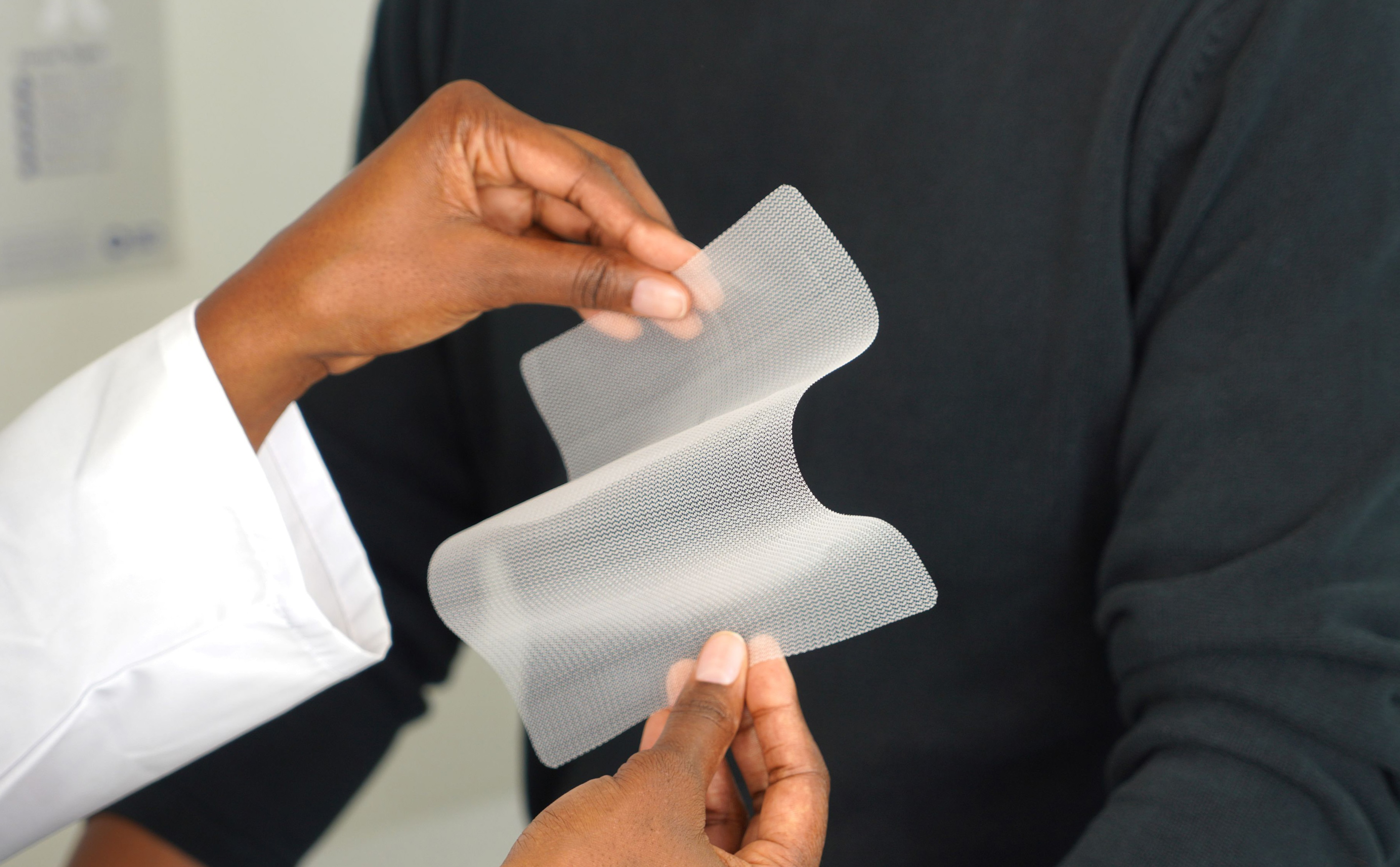
Want to get back to life without a permanent reminder? Consider Phasix™ Mesh—a fully absorbable option for hernia repair.

Ask about Phasix™ Mesh
Phasix™ Mesh is a bioresorbable (or absorbable) mesh, made of naturally occurring materials that are not considered foreign to the body and are designed to go away over time. It’s as strong as synthetic mesh, but the material in Phasix™ Mesh is intended to be absorbed into the body, leaving new tissue growth to protect and support the site of the repair with long-lasting strength. In this manner, Phasix™ Mesh provides a strong, reliable repair when you need it most.
Our handy discussion guide walks you through helpful questions to ask your doctor.
Experience what freedom from permanence feels like with Phasix™ Mesh
-

You have the control
Surgery is required, but the type of mesh is a choice you control.
-

Safe and effective
Phasix™ Mesh shows comparable outcomes to synthetics but avoids permanent material.
-

Doctors will listen
70% of surgeons surveyed say they would choose bioabsorbable mesh if patients ask.*
JOIN THE PHASIX™ MESH FAMILY
387K+ strong and counting
To date, the lives of over 387,000 patients have been impacted by Phasix™ Mesh.
Hear from real Phasix™ Mesh patients
Susana–From lifelong hernia to living life
"I was born with a hernia. I was operated on with Phasix™ Mesh, which gave me the freedom to go to the beach and do what I want... I'm back to going about my daily life without any limitations."


If you have any questions about Phasix™ Mesh,
please be sure to talk to a doctor.
To learn more about the mesh options for hernia repair BD offers,
you can email medical.information@bd.com or call 800-555-7422.
Your doctor will give you a patient implant card for the Phasix™ Mesh. Please keep this card somewhere safe and easy to find. The mesh implant information may be helpful for your future medical care.
*Internal data on file
INDICATIONS: Phasix™ Mesh is used to reinforce (support) soft tissue, where weakness exists, in patients having surgery on their belly, to change the way their body looks or works, or for rebuilding their tissue (otherwise known as abdominal, plastic, and reconstructive surgery). For example, Phasix™ Mesh could be used for ventral (near your belly) hernia repair or to help support your surgical wound.
DEVICE MODELS:1190616, 1190820, 1190830, 1190845, 1191025, 1191040, 1191530, 1192030, 1192040, 1193045, 1190200, 1190300, 1190400, 1190500, 1190808, 1190816, 1191010, 1191020, 1191525, 1192020, 1192540, 1193030, 1193535, 1194040, 1194545, 1190011, 1190100, 1195050.
IMPLANT MATERIAL: Phasix™ Mesh is made of poly-4-hydroxybutyrate (100%), that goes away slowly over time and is made from natural materials.
PURPOSE: Phasix™ Mesh is a sterile (germ-free) implant. It is a mesh implant used to fix soft tissue defects, like hernias or damage to the soft parts of your belly from trauma, illness, or prior surgeries, in adults.
WARNINGS AND PRECAUTIONS: The safety and usefulness of Phasix™ Mesh has not been evaluated in:
- Pregnant or breastfeeding women
- Infants or children
- Neurologic procedures or tissues (brain, spinal cord, and nerves)
- Cardiovascular tissue (heart or blood vessels)
- Breast reconstructive surgeries
The safety and effectiveness of Phasix™ Mesh in the proximity of (near) existing or excised (removed) cancer have not been established.
POTENTIAL ADVERSE REACTIONS (UNFAVORABLE):
- Adhesions: Adhesions form when internal scar tissue joins tissues together that are not usually joined. Adhesions to the bowel (the intestine) may lead to bowel obstruction (blockage). This can cause the need for multiple invasive procedures, prolonged hospitalization, long-term nursing care, intravenous nutrition, and/or staged surgery to fix the bowel.
- Allergic reaction: If you are allergic to tetracycline hydrochloride or kanamycin sulfate (antibiotics used to treat bacterial infections), please tell your doctor. An allergic reaction to the mesh may be difficult to diagnose after surgery due to distracting pain, fever, and use of sedatives and narcotics. These symptoms, if not recognized as an allergic reaction, may result in additional diagnostic and invasive procedures, which may include the need for reoperation or explanting (removing) the mesh.
- Mesh erosion: Erosion is the mesh rubbing against nearby soft tissue, and may result in the need for multiple invasive procedures, prolonged hospitalization, long-term nursing care, intravenous nutrition, and/or staged surgery to fix the bowel (or another organ). This may be followed by a hernia repair.
- Fistula formation: A fistula is an abnormal connection or passageway between an organ, vessel, or tissue. Fistula formation may result in the need for multiple invasive procedures, prolonged hospitalization, long-term nursing care, intravenous nutrition, and/or staged surgery to address the bowel (or another organ). This may be followed by a hernia repair.
- Hematoma: An accumulation of blood.
- Hemorrhage: Loss of blood.
- Surgical site infection: An infection localized at the surgical site may require oral or intravenous antibiotics and/or may result in additional diagnostic and invasive procedures, including the chance for reoperation and/or mesh removal.
- Inflammation: Swelling, redness, heat, and/or pain produced in an area of your surgery.
- Mesh extrusion: Mesh poking through the skin.
- Mesh migration: Mesh moves from where your doctor placed it during surgery.
- Pain: There is a possibility of pain which may affect quality of life and everyday functions, such as driving, walking up the stairs, and/or dressing oneself. Pain may continue and may require a second operation to remove the mesh.
- Recurrence: Return or reappearance of your hernia or soft tissue defect.
- Reoperation: If you require another operation in your belly before the Phasix™ Mesh has gone away, the mesh may need to be removed and may make that operation last longer.
- Seroma: An accumulation and pocket of clear fluid. This may result in unscheduled drainage or reoperation.
- Wound dehiscence: Your skin breaks open along the line where your belly was sewn closed after surgery. This may lead to exposure of the mesh to the open air, which may result in additional complications including an unscheduled reoperation.