BD Aptra™ Single-Use Digital Flexible Cystoscope
A flexible solution for advancing urological care.
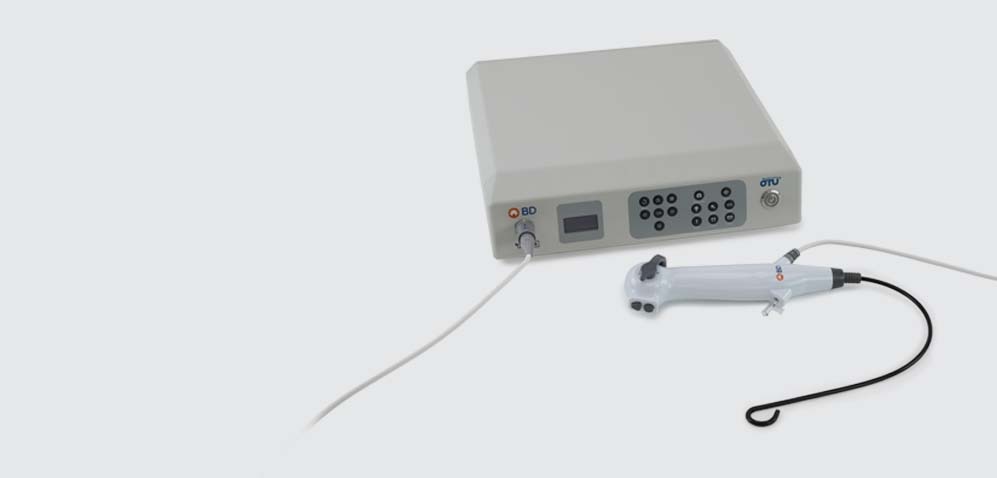

Power of a partner
BD is one of the largest global medical technology companies in the world and is advancing the world of health by improving medical discovery, diagnostics and delivery of care. BD helps customers enhance outcomes. lower costs, increase efficiencies, improve safety and expand access to health care. BD Aptra™ Single-Use Digital Flexible Cystoscope is another step in furthering our mission.
Adopt the BD Aptra™ System and partner with a dedicated procedural specialist through product training, adoption, integration, and troubleshooting.
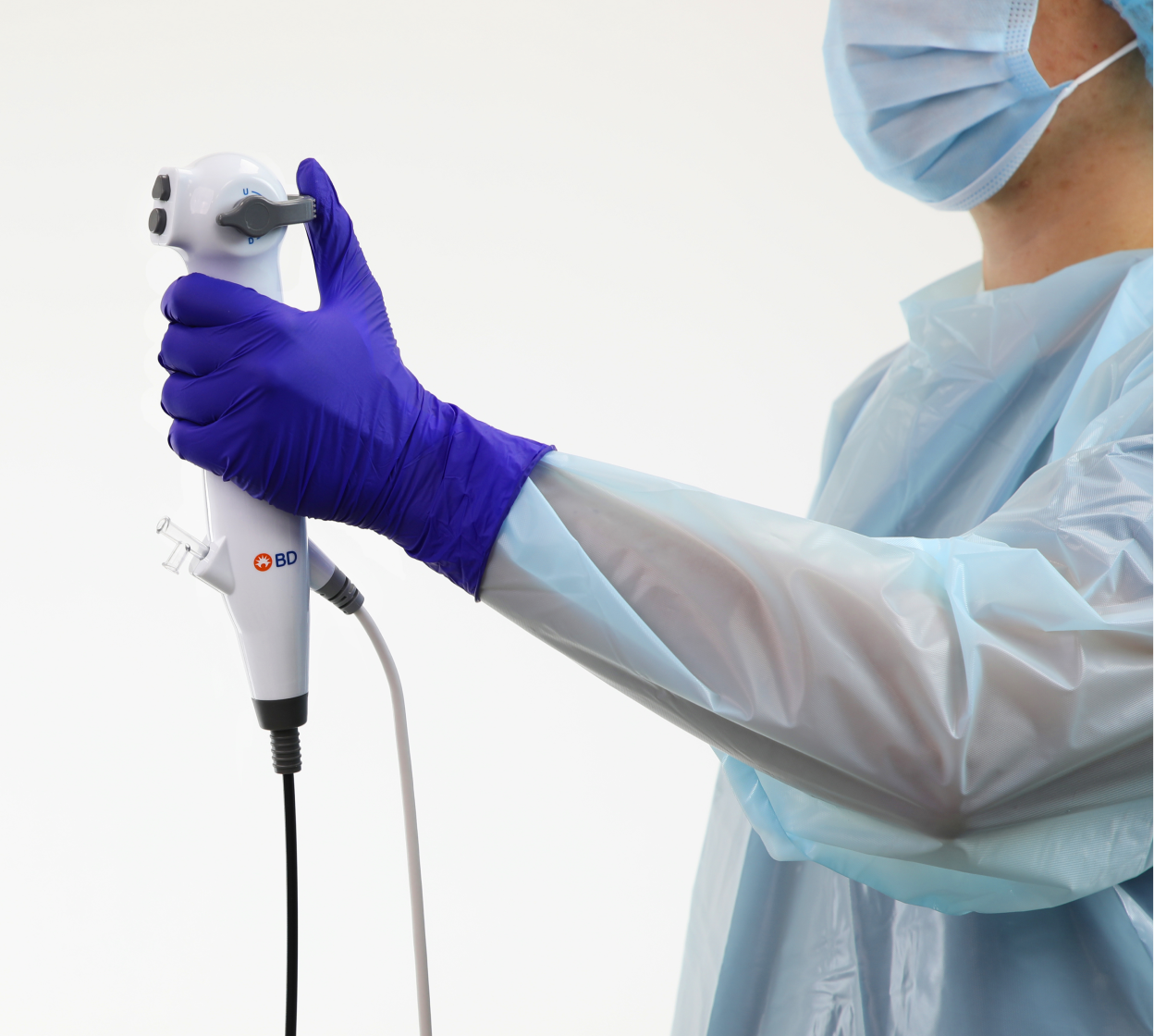
Reduced risk of infection
Choose single-use cystoscopes and decrease the potential risk of infection post-procedure or other possible contamination associated with reprocessing reusable scopes.
0% of patients reported UTIs
3.1% of patients reported UTIs after cystoscopy for stent removal with a reusable scope compared to 0% of patients reporting infection after a cystoscopy with single use.1
Lower number of post-procedural encounters and positive urine cultures
Patients who had cystoscopy with a disposable cystoscope were associated with a lower number of post-procedural encounters and positive urine cultures.2
Optimized case efficiency
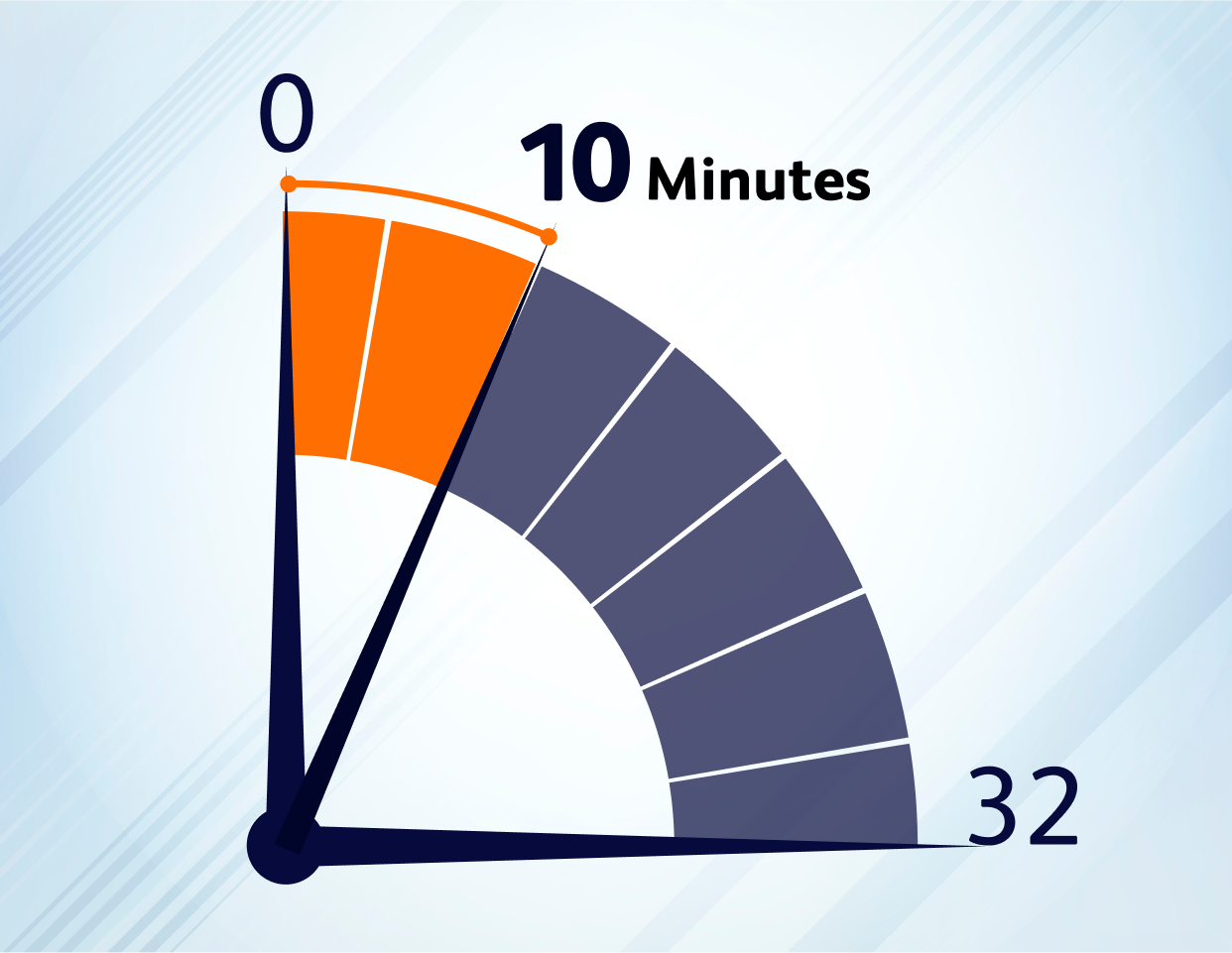
Choose single-use cystoscopes for reduced labor time.
- The average labor time spent per case with single-use scopes was 10-minutes, compared with 32 minutes with reusable cystoscopes.5
- Single-use cystoscopes significantly reduced hands-on labor time for pre- and post-procedure compared to reusable cystoscopes.4
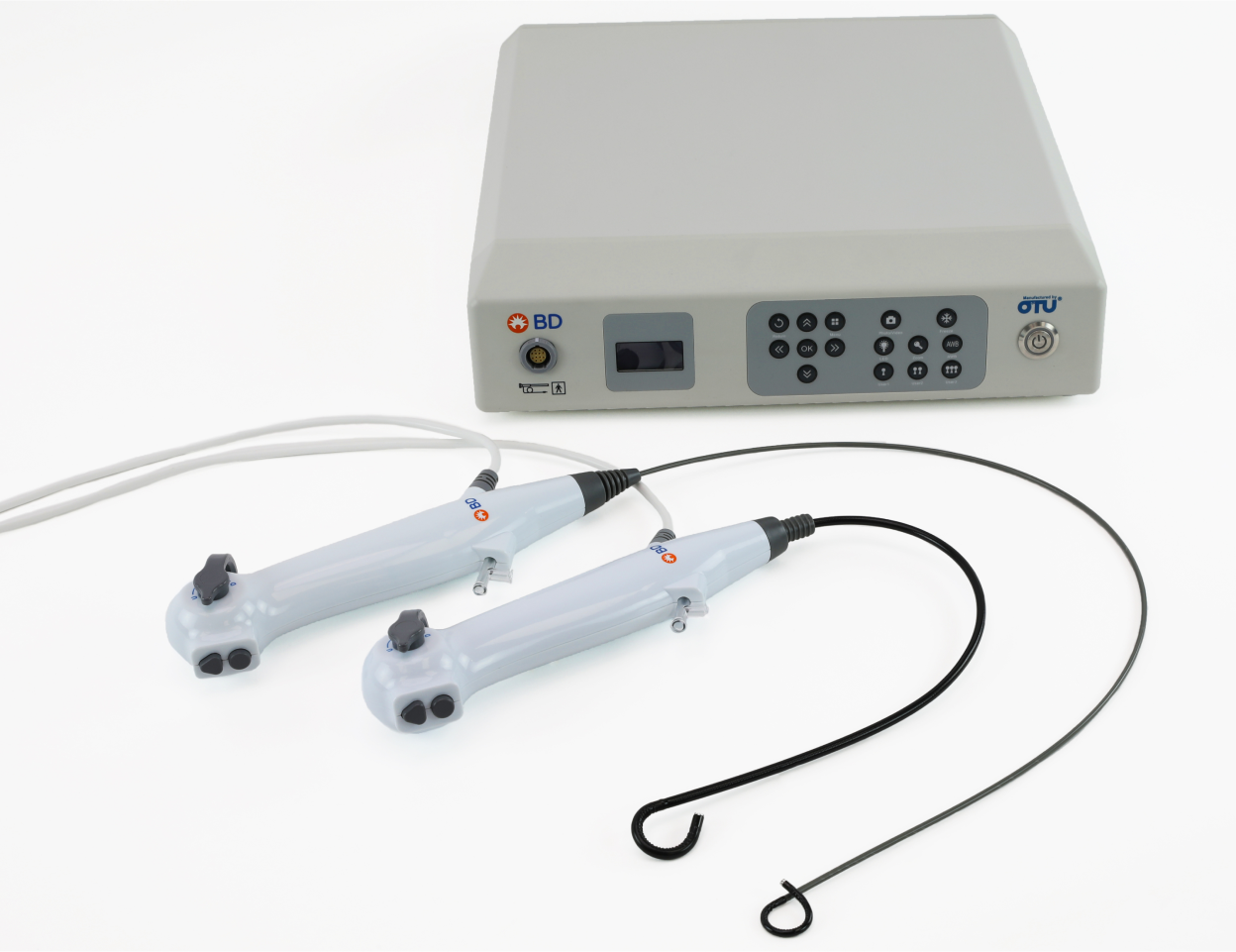
Choose one system, two scopes for streamlined OR workflow.
BD Aptra™ Single-Use Digital Flexible Cystoscope is compatible with BD Aptra™ Image System, offering consistency and optimized productivity for the surgical team.

Reprocessing time savings
Choose single-use cystoscopes and save time and money associated with wear or breakage, sterilization failure, and high purchase and repair costs.
42 minutes and 1 second
Total reprocessing time saved per scope for single-use cystoscope users, excluding pre-cleaning.4
Invest in dependability with BD Aptra™ Single-Use Digital Flexible Cystoscope.

Cancelled or rescheduled cases
The value of reusable cystoscopes is diminished when they're not available or when performance is degraded through reprocessing and repair.
Case are postponed or delayed.
When another scope is not available, it costs time and money, causes provider frustration and inconvenience for patients and family.
Stick to the schedule with BD Aptra™ Single-Use Digital Flexible Cystoscope.
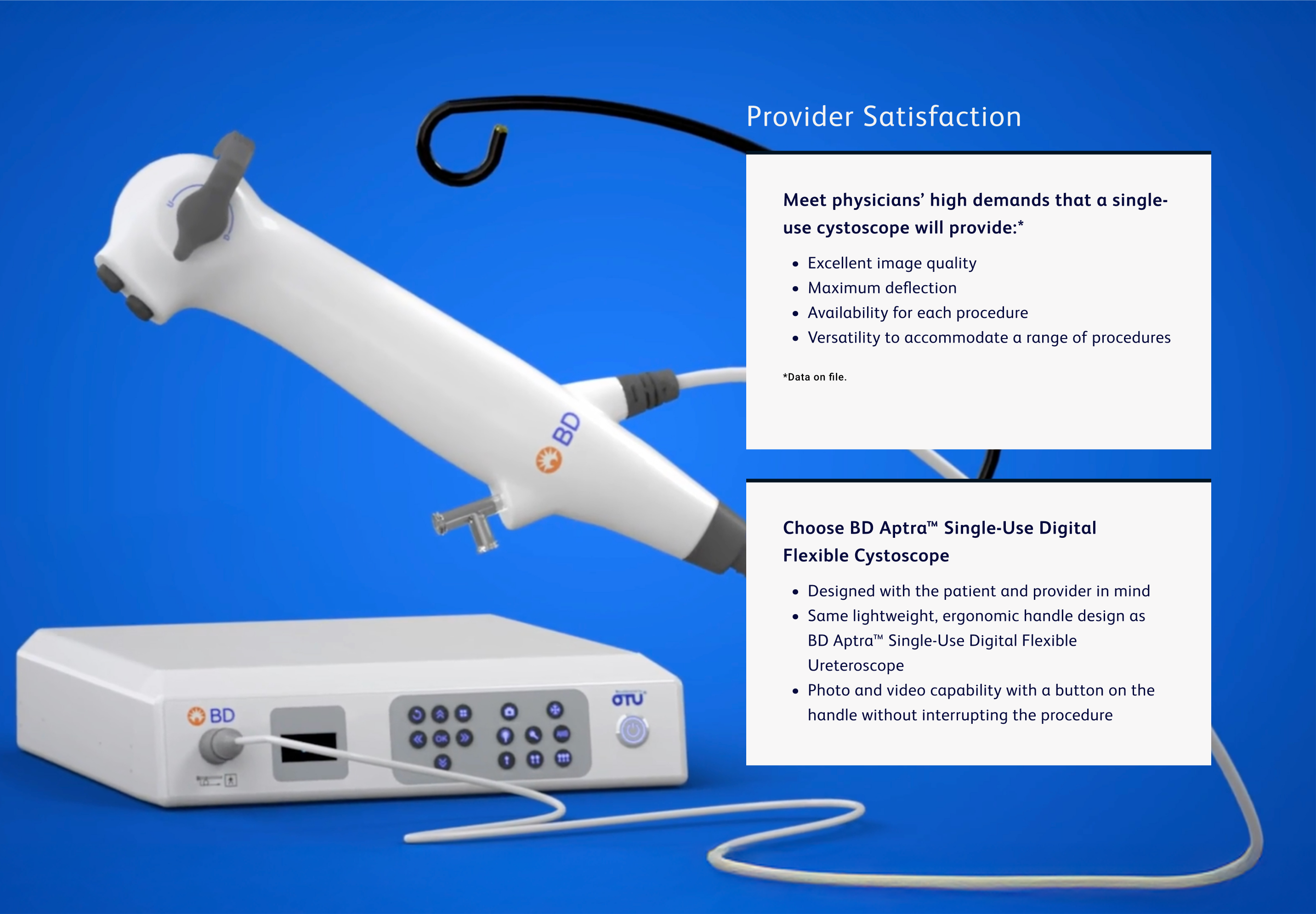
Better patient experience
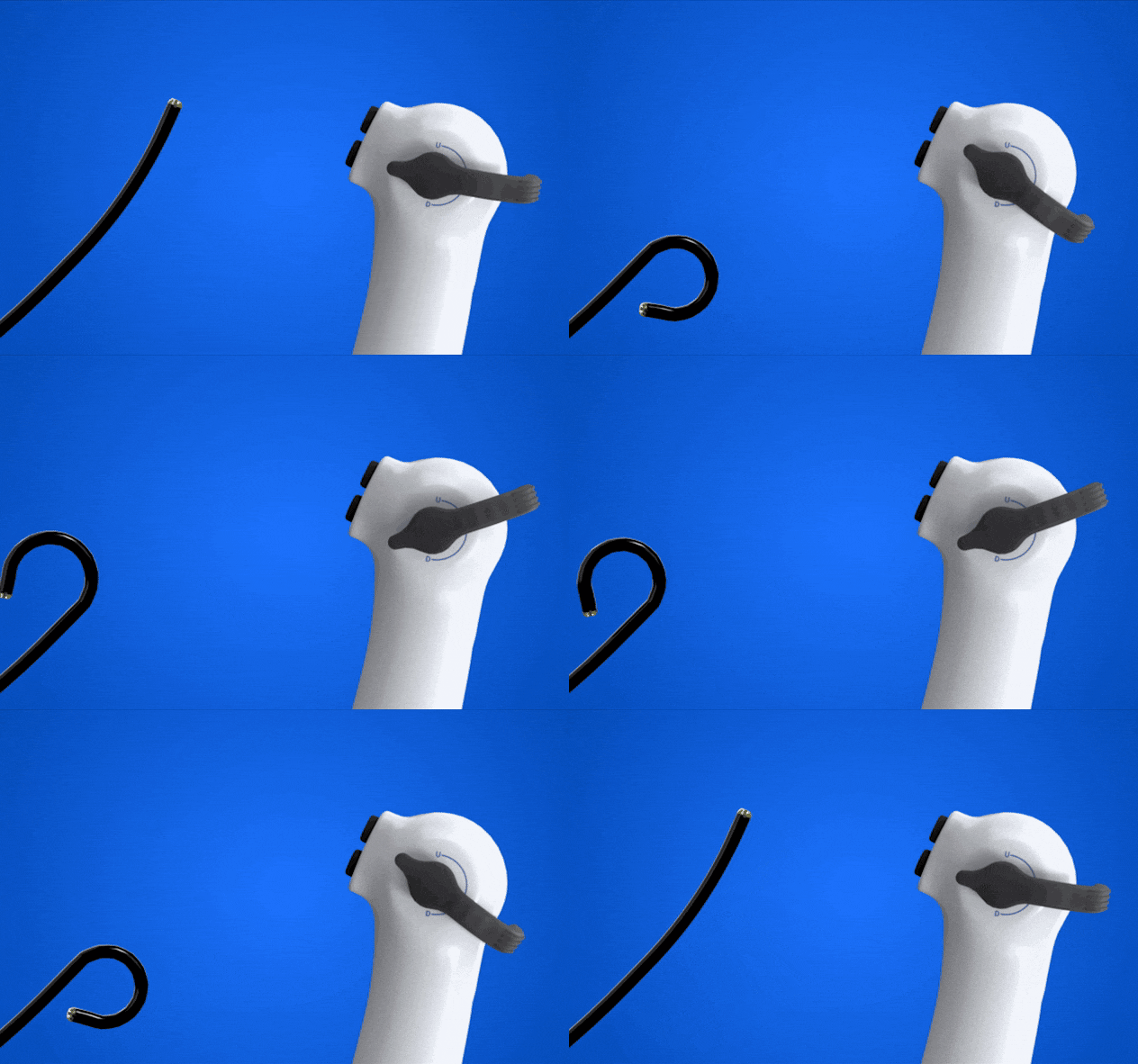
Choose flexible cystoscopes
Decrease potential pain for patients associated with rigid cystoscopes in diagnostic cystoscopy.3

Choose single-use cystoscopes
Reduce the risk of patient procedures being delayed if a resuable scope is unavailable or when performance is degraded due to reprocessing and repair.
- Alkhamees, M.; Alothman, A.; et al. Reusable vs. single-use cystoscope for removal of double-J stent: a prospective randomized comparison and cost analysis. Eur Rev Med Pharmacol Sci. 2022; 26: 4628-4273.
- Geldmaker, L.E.; Baird, B.A.; et al. Conversion to Disposable Cystoscopes Decreased Post-Procedure Encounters and Infections Compared to Reusable Cystoscopes. American Urological Association Journal. 2023; 10: 311-318.
- Seklehner, S.; Remzi, M.; et al. Prospective Multi-institutional Study Analyzing Pain Perception of Flexible and Rigid Cystoscopy in Men. Urology. 2015; 85: 737-741.
- Haislip, I.; Rindorf, D.; et al. Workfl ow effi ciencies for fl exible cystoscopy: comparing single-use vs reusable cystoscopes. BMC Urol. 2024; 24: 53.
- Young, J.A.; Garden, E.B.; et al. Journal Briefs: The Journal of Urology: Disposable versus Reusable Cystoscopes - A Micro-Costing Value Anaylsis in High-Volume and Low-Volume Urology Practices. Journal of Urology. 2021; 8: 466.
Intended Use
BD Aptra™ Digital Cystoscope System is intended to be used by physicians to access, visualize, and perform procedures in the bladder and lower ureter. The instrument enables delivery and use of accessories such as biopsy forceps, laser fibers, graspers, and retrieval baskets at a surgical site.
Contraindications
Diagnostic or therapeutic endoscopy is contraindicated in people with an untreated urinary tract infection. Other contraindications to therapeutic endoscopy (e.g. lithotripsy, endopyelotomy, tumor therapy) are more numerous and can mirror those associated with the corresponding open surgical interventions. Patients on anticoagulants or with coagulopathies should be managed appropriately.
Warnings
- Do not use electromedical energy sources in the presence of flammable detergents, anesthetics, nitrous oxide(N20), or oxygen.
- Consult the user manuals of all electromedical energy sources used with endoscopic instruments for appropriate instruments, warnings, and cautions prior to use. Such sources of energy include electrical, electrohydraulic, electrosurgical, heat hydraulic, laser, light, pressure, sound, ultrasound, and vacuum.
- Do not insert or advance the cystoscope unless there is a clear live endoscopic view of the lumen through which the scope is being advanced(or confirm with visualization by other imaging modalities).
- During the procedure, if the live endoscopic image is lost, do not advance or insert the cystoscope and do not insert, advance or actuate accessories.
- Do not use excessive force while advancing or withdrawing the scope. If resistance is felt during advancement or withdrawal of the scope, investigate the source of resistance and/or take remedial action if necessary.
- Do not force the distal tip of the cystoscope against the sidewall of the bladder or urethra.
- Do not use excessive force when advancing or withdrawing an accessory within the cystoscope.
- When inserting or using accessories, maintain continuous visualization of the distal tip. Ensure that the distance between the distal tip of the cystoscope and the object in view is greater than the cystoscope’s minimum visible distance. Failure to do so may result in the accessories causing patient injury.
- Do not withdraw a laser fiber back into the cystoscope while the laser is firing. Doing so may cause patient injury and/or scope damage.
- Do not look directly into the light emitted from the cystoscope.
- Verify ground isolation when setting up and using accessories from different manufacturers prior to procedure.
- Do not open the handle of the cystoscope.
- The cystoscope is a single-use device and there are no serviceable parts. Do not repair damaged or non-operating cystoscopes. Do not use the cystoscope if damage is discovered or suspected.
- Do not excessively bend the flexible shaft or the articulating section of the cystoscope.
- If damage to the cystoscope occurs or it stops functioning during a procedure, stop using the cystoscope immediately. See troubleshooting section for more information. Continue the procedure with a new cystoscope, as appropriate.
- Inflow of gas e.g. supplied by endoscopic accessories or due to over-insufflation of gas may cause gas embolism, leading to stroke or ischemia in tissue.