


RELATED PRODUCTS NOT AVAILABLE
true

Support
Customer service and ordering

866 979 9408
Contact Us
Thank you for contacting our sales team!
A sales representative will contact you shortly.
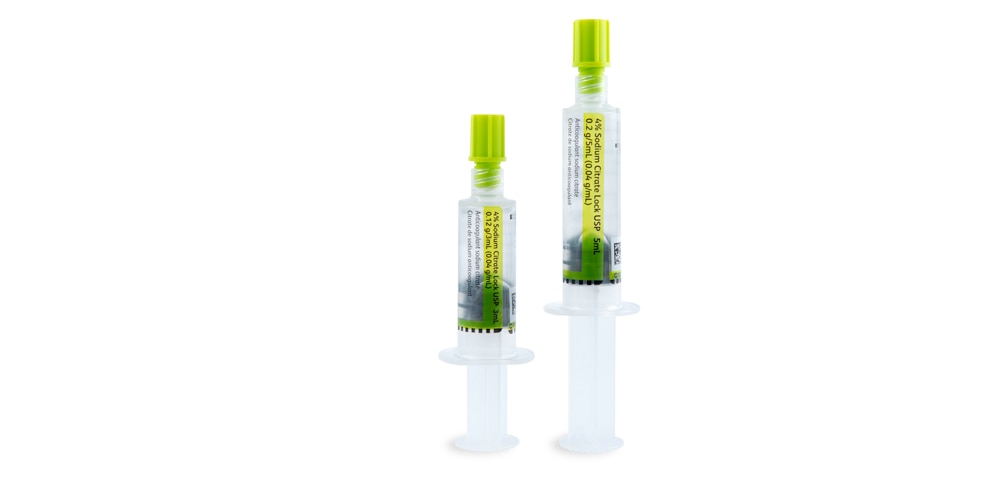
BD PosiFlush™ 4% sodium citrate pre-filled lock syringe
Maximize catheter patency and minimize risk of adverse events with BD PosiFlush™ 4% sodium citrate pre-filled lock syringes.

- Overview
- Products & Accessories
- EIFU & Resources
false
true
Maintaining catheter patency and preventing catheter-related bloodstream infections (CRBSIs) are central goals in vascular access management. BD PosiFlush™ pre-filled syringes are uniquely designed to standardize and enhance best clinical practice for improved patient outcomes and greater clinical efficiency. With a full range of flushing and locking solutions, including a new 4% sodium citrate lock solution, BD PosiFlush™ pre-filled syringes provide clinicians with the right tools to meet their clinical needs. Recommended by clinical practice guidelines as an alternative to heparin,1 4% sodium citrate provides equivalent catheter patency while offering an improved safety profile, reduction in the risk of CRBSIs and prevention of biofilm formation—all at a lower cost13.
Maximize catheter patency, minimize risk*
4% sodium citrate lock solution reduced the number of hemodialysis catheters exchanged per 1,000 days by 59% vs heparin 5,000 U/mL (1.33 vs 3.24, p = 0.002).1
Fewer CRBSIs vs heparin 5,000 U/mL*
45% fewer catheter-related bloodstream infections (CRBSIs) (11 vs 20; p = 0.026) and 57% fewer CRBSIs/1,000 catheter-days (0.81 vs 1.90; p = 0.026).1
Supported by guidelines
Recommended by several international guidelines, including INS 20162, CVAA 20133, CANNT4, ASDIN 20085 and ERBP 2007.6
Fewer bleeding events vs heparin 5,000 U/mL*
67% reduction in systemic bleeding events (7 vs 21; p = 0.035) with no risk of heparin-induced thrombocytopenia.6
Equivalent anticoagulation and maintenance of catheter patency 1,7–10*
Similar antithrombotic efficacy and maintenance of catheter function vs heparin 5,000–10,000 U/mL.
Equivalent patency without heparin-related adverse events 1,7–10*
Not associated with systemic anticoagulation, bleeding risks or heparin-induced thrombocytopenia (HIT).
Associated with significantly fewer CRBSIs 1,7–10*
Significantly fewer CRBSI with 4% sodium citrate vs 5,000 U/mL heparin (0.81 vs 1.90/1,000 catheter-days, p = 0.026).
May help prevent biofilm formation 11,12*
Efficiently inhibits biofilm formation and cell growth of S. aureus and S. epidermidis.
Improve CVC dwell time 1,7–10*
Time from catheter insertion to CVC exchange was significantly improved (p = 0.04).
May be more cost-effective than heparin locks in vials 7,9*
Up to 85% reduction in the costs associated with catheter-locking vs. heparin. 8

 BD PosiFlush™ 4% Sodium Citrate Pre-Filled Lock Syringes brochure
* Current data only validated in hemodialysis catheters.
- Yon CK, Low CL. Sodium citrate 4% versus heparin as a lock solution in hemodialysis patients with central venous catheters. Am J Health Sys Pharm. 2013;70(2):131-136.
- Gorski LA, Hadaway L, Hagle ME, McGoldrick M, Orr M, Doellman D. Infusion therapy standards of practice. J Infus Nurs. 2016;39(Suppl 1):S1-S159.
- Hill J, Broadhurst D, Miller K, et al. Occlusion management guideline for central venous access devices (CVADs). Vascular Access. 2013;7(Suppl 1):1-34. 4.
- Canadian Association of Nephrology Nurses and Technologists. Nursing recommendations for the management of vascular access in adult hemodialysis patients: 2015 update. CANNT J. 2015;25( Suppl 1):1-48.
- Moran JE, Ash SR, ASDIN Clinical Practice Committee. Locking solutions for hemodialysis catheters; heparin and citrate—a position paper by ASDIN. Semin Dial. 2008;21(5):490-492.
- MacRae JM, Dojcinovic I, Djurdjev O, et al. Citrate 4% versus heparin and the reduction of thrombosis study (CHARTS). Clin J Am Soc Nephrol. 2008;3(2):369-374.
- Grudzinski L, Quinan P, Kwok S, Pierratos A. Sodium citrate 4% locking solution for central venous dialysis catheters—an effective, more cost-efficient alternative to heparin. Nephrol Dial Transplant. 2007;22(2):471-476.
- Grudzinski A, Agarwal A, Bhatnagar N, Nesrallah G. Benefits and harms of citrate locking solutions for hemodialysis catheters: a systematic review and meta-analysis. Can J Kidney Health Dis. 2015;13(2)1-12.
- Lok CE, Appleton D, Bhola C, Khoo B, Richardson RMA. Trisodium citrate 4% - An alternative to heparin capping of haemodialysis catheters. Nephrol Dial Transplant. 2007;22(2):477-483.
- Tordoir J, Canaud B, Haage P, et al. EBPG on vascular access. Nephrol Dial Transplant. 2007;22(Suppl 2):ii88-ii117.
- Jones SM, Ravani P, Hemmelgarn BR, Muruve D, MacRae JM. Morphometric and biological characterization of biofilm in tunneled hemodialysis catheters. Am J Kidney Dis. 2011;57(3):449-455.
- Shanks RMQ, Sargent JL, Martinez RM, Graber ML, O’Toole GA. Catheter lock solutions influence staphylococcal biofilm formation on abiotic surfaces. Nephrol Dial Transplant. 2006;21(8):2247-2255.
- Gorski LA, Hadaway L, Hagle ME, McGoldrick M, Orr M, Doellman D. Infusion therapy standards of practice. J Infus Nurs. 2016;39(Suppl 1):S1–S159.
true