true
Icon to close the modal
Contact Us
Sales
Modal Close Icon
Icon to close thank you modal
Thank you for contacting our sales team!
A sales representive will get in touch with you shortly.
Customer Care
Phone Icon
0800 917 8776
BDUK_customerservice@bd.com

BD® Sherlock 3CG+™ Tip Confirmation System

Contact Us
sherlock-3cg-plus
Loading
Overview

How can CVAD tip placement be verified without waiting for an X-ray?

Sherlock 3CG+ Tip Confirmation System (TCS) is indicated to be used in adult and adolescent (greater than 12 through 21) patients with Central Venous Advanced Devices (CVADs),* such as peripherally inserted central catheters (PICCs), central venous catheters (CVCs), implantable ports, and haemodialysis catheters; it is also indicated to be used in children, infants, and neonates with PICCs and centrally inserted central catheters (CICCs).

The Sherlock 3CG+ TCS is designed to aid in CVAD tip positioning of catheters at least 2 Fr in size through real time navigation and electrocardiogram (ECG) technology.

The Sherlock 3CG+ TCS is indicated as an alternative method to chest X-ray (CXR) and fluoroscopy for CVAD tip placement, eliminating harmful radiation. When compared to traditional PICC placement methods of blind placement and CXR, it has demonstrated proven time and observed cost savings, specifically reduction in time to release PICC patients for IV therapy, malposition rates and CXRs.†,††

true
Features and Benefits

How does ECG-guided CVAD tip placement work?

Real-time interface

featuring catheter navigation information with Sherlock Magnet Navigation and/or ECG-based navigation.

Catheter tip placement confirmation

with identifiable P-wave via the patient’s cardiac electrical activity. Also includes visual cues for identifying the P-wave and max P-wave.

The through-drape connection

maintains the sterility of the caregiver without compromising the safety or health of patients.

Compatible with Maximal Barrier+ PICC Trays,

which are designed to improve catheter tip tracking accuracy and reliability.

Can Sherlock 3CG+ TGS be used on children?

One of the only systems on the market indicated for paediatrics.

Is a chest X-ray needed after PICC insertion?

Sherlock 3CG+ TGS eliminates the need for confirmatory X-ray of PICCs 2 Fr and larger in patients with an identifiable Pwave of approaches from the superior vena cava.

99.1% first-time catheter placement rate

using BD tip confirmation technology on adult patients with an identifiable P-wave when compared to fray.§,1

May save your facility up to 26% in costs

compared to blind placement with X-ray confirmation.†,††

Together, we all play a part in preventing vascular access complications.

BD Vascular Access Management Assessments

BD Vascular Access Management assessments

Our powerful evidence-based assessments, with analytics and benchmarks, are the first phase of BD Vascular Access Management—and the first step on the path to enhance patient safety, workflow efficiency and cost-effectiveness across the entire patient journey.

Learn more

PARTNER WITH BD

References

Please note, not all products, services, claims or features of products may be available or valid in your local area. Please check with your local BD Representative.

Please consult BD product labels and inserts relevant to your geography for any indications, contraindications, hazards, warnings, cautions and instructions for use. Any discussion and/or content regarding BD products is limited to this information and instructions for use.

* In each specific age group, the CVAD type and size must be chosen and the CVAD must be used according to the CVAD's indications and instructions for use.

Company sponsored study comparing Sherlock 3CG+ Tip Confirmation System on adult patients against historical PICC placement standard of care for blind insertion followed by a chest X-ray (CXR) for tip confirmation. Data on file.

†† Reduced cost based on post-hoc exploratory analysis suggesting the costs between the two placement processes are different. The Sherlock 3CG+ Tip Confirmation System (TCS) is indicated for navigation and positioning of central venous access devices (CVADs) of at least 2 Fr in size.

The Sherlock 3CG+ TCS provides real-time catheter tip location information by using catheter navigation technology along with the patient's cardiac electrical activity and is indicated for use as an alternative method to chest X-ray Sherlock 3CG+ TCS and fluoroscopy for CVAD tip placement confirmation of approaches from the superior vena cava.

In adult patients and in adolescents (greater than 12 through 21 years of age), the Sherlock 3CG+ TCS can be used with CVADs such as peripherally inserted central catheters (PICCs), central venous catheters (CVCs), implantable ports and hemodialysis catheters; in children (greater than 2 to 12 years of age), in infants (greater than 1 month to 2 years of age) and in neonates (from birth to 1 month of age), the Sherlock 3CG+ TCS can be used with PICCs and with centrally inserted central catheters (CICCs). In each specific age group, the CVAD type and size must be chosen and the CVAD must be used according to the CVAD's indications and instructions for use.

Limiting but not contraindicated situations for this method are in patients where alterations of cardiac rhythm change the presentation of the P-wave as in atrial fibrillation, atrial flutter, severe tachycardia and pacemaker driven rhythm. In such patients, who are easily identifiable prior to catheter insertion, the use of an additional method is required to confirm catheter tip location.

§In a clinical study, 332 subjects received vascular access devices in the form of PICCs, ports and tunneled catheters of which 114 received PICCs. Placement of PICCs were deemed acceptable in 99.1% (113/114) of the subjects. Pittiruti M (2010) evGuide-Sapiens TLS Post-market Clinical Study Report. Catholic University Hospital.

1. Pittiruti M, Bertollo D, Briglia E, et al. The Intracavitary ECG Method for Positioning the Tip of Central Venous Catheters: Results of an Italian Multicenter Study. The Journal of Vascular Access. 2012;13(3):357-365. doi:https://doi.org/10.5301/jva.2012.9020

true
Integrated Solutions

Simplify PICC tip placement

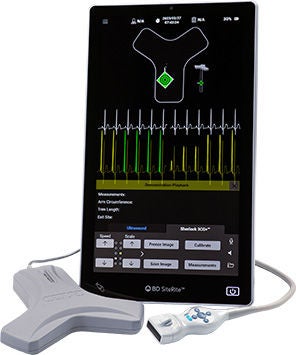
The Sherlock 3CG+™ TCS simplifies the PICC insertion process by combining CVAD tip placement technology into select BD® SiteRite™ Ultrasound Systems.

What is the BD® SiteRite Ultrasound System?

The BD® SiteRite™ 8 Ultrasound System is a "one-stop shop" for PICC placement:

  • Evaluate and assess patient vasculature
  • Select and access the appropriate vessel
  • Use the Sherlock 3CG+ TCS tip tracking technology to locate and navigate the catheter tip to the superior vena cava (SVC)
  • Use the ECG technology to distinguish changes in P-wave amplitude
  • Confirm catheter tip placement at the cavoatrial junction (CAJ) without the need for a confirmatory chest X-ray
References

Please note, not all products, services, claims or features of products may be available or valid in your local area. Please check with your local BD Representative.

Please consult BD product labels and inserts relevant to your geography for any indications, contraindications, hazards, warnings, cautions and instructions for use. Any discussion and/or content regarding BD products is limited to this information and instructions for use.

Standalone System

Can Sherlock 3CG+ TCS be used without the BD® SiteRite Ultrasound System?

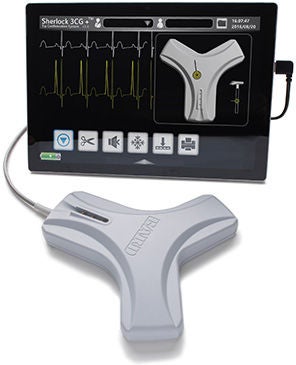
The Sherlock 3CG+ Tip Confirmation System (TCS) is available as a separate standalone system for customers not using the BD® SiteRite 8 Ultrasound System. This device provides the same great benefits of the integrated system but provides flexibility for use across multiple imaging platforms.

References

Please note, not all products, services, claims or features of products may be available or valid in your local area. Please check with your local BD Representative.

Please consult BD product labels and inserts relevant to your geography for any indications, contraindications, hazards, warnings, cautions and instructions for use. Any discussion and/or content regarding BD products is limited to this information and instructions for use.

Clinical Study

What's the clinical evidence on Sherlock 3CG+ Tip Confirmation System (TCS)? 


Using X-ray to confirm PICC tip placement exposes patients to harmful radiation and delays medical therapy. The Sherlock 3CG+™ TCS gets to the heart of this problem by using an adult and paediatric patient's cardiac electrical activity when approaching the superior vena cava to position the tip of the PICC in close proximity to the cavoatrial junction (CAJ). Final tip location is confirmed by the nurse at the bedside and infusion therapy can begin immediately without the need for a confirmatory chest x-ray.


In a clinical study, 99.1% of 114 PICCs were placed at the CAJ or within +/- 1 cm using BD Tip Confirmation Technology.1

References

Please note, not all products, services, claims or features of products may be available or valid in your local area. Please check with your local BD Representative.

Please consult BD product labels and inserts relevant to your geography for any indications, contraindications, hazards, warnings, cautions and instructions for use. Any discussion and/or content regarding BD products is limited to this information and instructions for use.

1. Pittiruti M, Bertollo D, Briglia E, et al. The Intracavitary ECG Method for Positioning the Tip of Central Venous Catheters: Results of an Italian Multicenter Study. The Journal of Vascular Access. 2012;13(3):357-365. doi:https://doi.org/10.5301/jva.2012.9020

EIFUs
Resources
true
Sherlock 3CG+™ Tip Confirmation System BD Tip confirmation systems Sherlock 3CG+™ Tip Confirmation System Sherlock 3CG+™

Real-time interface

,

featuring catheter navigation information with Sherlock Magnet Navigation and/or ECG-based navigation.

,

Catheter tip placement confirmation

,

with identifiable P-wave via the patient’s cardiac electrical activity. Also includes visual cues for identifying the P-wave and max P-wave.

,

The through-drape connection

,

maintains the sterility of the caregiver without compromising the safety or health of patients.

,

Compatible with Maximal Barrier+ PICC Trays,

,

which are designed to improve catheter tip tracking accuracy and reliability.

,

Can Sherlock 3CG+ TGS be used on children?

,

One of the only systems on the market indicated for paediatrics.

,

Is a chest X-ray needed after PICC insertion?

,

Sherlock 3CG+ TGS eliminates the need for confirmatory X-ray of PICCs 2 Fr and larger in patients with an identifiable Pwave of approaches from the superior vena cava.

,

99.1% first-time catheter placement rate

,

using BD tip confirmation technology on adult patients with an identifiable P-wave when compared to fray.§,1

,

May save your facility up to 26% in costs

,

compared to blind placement with X-ray confirmation.†,††

/content/dam/bd-assets/bd-com/en-us/logos/bd/header-bd-logo.svg bar000280 BD® Sherlock 3CG+™ Display Rollstand Mounting Bracket amp09us BD® Sherlock 3CG+™ Standalone Display Remote Control 9770368 BD® Sherlock 3CG+™ Large Sensor