Prior to use, please see the complete Instructions for Use for more information on Indications, Contraindications, Warnings, Precautions and Adverse Events.
Indication for Use
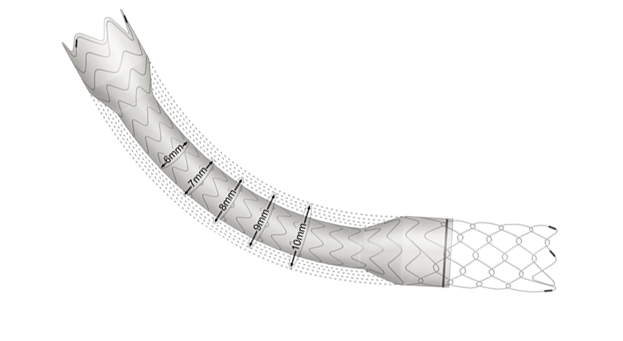
The Liverty™ TIPS Stent Graft is indicated for the treatment of complications of portal hypertension.
Select Warnings
When placing a shunt with a final diameter of ≤8 mm, the leading 20 mm of the covered stent graft segment must be additionally dilated with an 8 mm balloon for at least 25 seconds to help reduce the risk of thrombosis. · Potential allergens: This device contains nitinol, an alloy made of nickel and titanium, tantalum and tungsten. · If multiple stent grafts are placed in an overlapping fashion, they should be of similar composition (i.e., nitinol (nickel-titanium alloy)). · The potential benefits of a Transjugular Intrahepatic Portosystemic Shunt (TIPS) procedure should be carefully weighed against the potential risks. Consult clinical practice guidelines to identify special considerations for patients with pre-existing conditions, including, but not limited to: Congestive heart failure or severe cardiac valvular insufficiency; Elevated right or left heart pressure; Severe or moderate pulmonary hypertension.
Select Precautions
The stent graft implant cannot be repositioned after complete deployment of the covered stent graft segment. · A stent graft which is misplaced and extends too far into the vena cava or portal vein may cause thrombosis and/or difficulties during liver transplant surgery. · The covered segment of the stent graft should line the entire parenchymal tract and hepatic vein to the hepatocaval junction. Inadequate coverage of the hepatic vein may lead to stenosis in an unlined hepatic vein segment. · The stent graft must not be post-dilated beyond 10 mm diameter. · Wait for 7 days after placement of the Liverty™ TIPS Stent Graft before performing surveillance ultrasound assessment of the shunt because air in the pores of the ePTFE may provide inaccurate information about the shunt patency.
Potential Complications may include, but are not limited to:
Cholestasis; Congestive heart failure; Embolism; Hemoperitoneum; Hepatic encephalopathy; Hepatic infarction; Liver failure/dysfunction; Peritonitis; Recurrence of Ascites; Renal failure.