

Innovation In Drug Delivery
From Emerging Concepts to System Level, Deployable Solutions.

- Dual Injection
- Sensitive Biologics
- High Mass Dose Delivery
- Traceability & Manufacturing
- Solution Approach & Partnerships

Innovation in combination product development requires the management of complexities such as increasing injection volume, viscosity, and delivery demands, as well as evolving regulatory requirements.
BD Pharmaceutical Systems is committed to developing innovations that address those needs and help pharma and biotech partners bring critical medicines to patients as they balance formulation science, delivery performance, manufacturability, usability and patient
experience.1-4
Addressing the limitations of co-formulation in combination therapies
Combination therapies involving multiple liquid drug products are becoming increasingly common across the biopharmaceutical pipeline. While coformulation can offer therapeutic and patient-centric benefits, it is often constrained by formulation incompatibilities, stability concerns, and increased technical complexity-particularly when applied to biologics.3,5

Pharma challenge
Pharmaceutical developers frequently encounter situations where two liquid drug products:
- cannot be co-formulated due to differences in pH, excipients, or chemical and physical stability.
- must remain physically separated to prevent long-term interactions prior to administration.
- Still need to be administered through a single injection.
Existing dual-chamber or combination delivery solutions can address some of these needs, but often require validation of new materials, additional components, and/or significant changes to secondary device systems to allow for integration.3,5

BD innovation approach
BD is developing a dual-injection valve and syringe system, enabling the physical separation of two liquid drugs until point of injection. This system allows for dual chamber functionality while maintaining compatibility with standard prefillable syringes, related components, and secondary device systems, such as auto-injectors.3,5
This approach is built on:
- incremental design strategies, leveraging known materials and established container architectures to reduce development and regulatory risk;
- physics-based modeling and simulation to evaluate mechanical behavior, valve performance, injection forces, and system robustness early in development;
- early assessment of fill-finish processability and integration feasibility with legacy manufacturing lines and existing autoinjector platforms.3,5
By prioritizing system compatibility and integration, these emerging concepts aim to expand dual-drug delivery options while minimizing the burden of change for pharmaceutical developers.3
Managing silicone related risks in prefillable syringe systems
Some biologic drug products may be highly sensitive to silicone lubrication used in prefillable syringe systems. In particular, interactions between biologic formulations and silicone lubrication have been identified as a potential contributor to subvisible particle formation, with implications for product quality and regulatory risk6.
As a result, container solutions are being developed to mitigate silicone-related risks while preserving compatibility with established materials, manufacturing processes, and regulatory expectations7,8.
A customer challenge rooted in formulation sensitivity
Developers must balance competing requirements:
-

Silicone lubrication is necessary to ensure consistent functional performance, including break loose and glide forces8
-

Mobile silicone oil has been associated with increased subvisible particle levels in certain protein formulations6
-

Modifying the primary container system may require changes to materials and processes7,8
As a result, approaches focus on reducing silicone-related risks while maintaining compatibility with established materials, manufacturing processes, and regulatory expectations7,8.
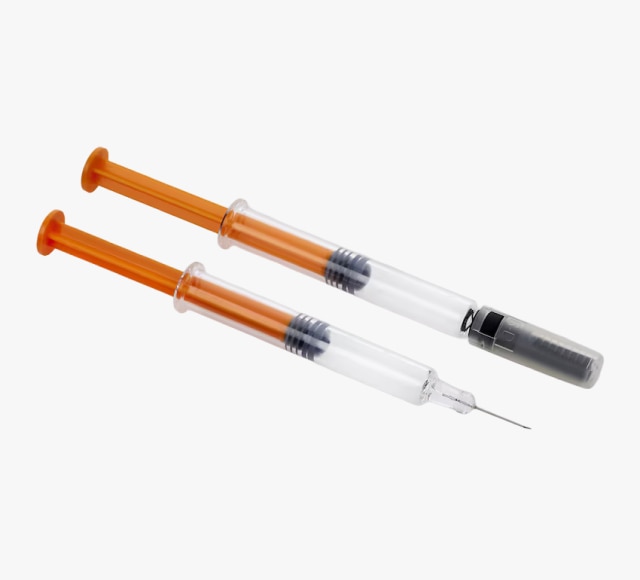
BD NeopakTM XSiTM Glass Prefillable Syringe - controlled silicone distribution
BD XSiTM coated syringes have been designed to improve the integrity of the lubricant layer, reducing subvisible particle levels in biologic formulations within prefillable syringe systems, particularly for drugs that may be sensitive to silicone oil6,7.
BD NeopakTM XSiTM Glass Prefillable Syringe combines BD standard glass PFS system with a proprietary advanced coating technology based on cross-linked silicone, designed to improve the integrity of the lubricant layer compared with conventional silicone.
The technology is designed to:
-

Stabilize the silicone lubricant layer to reduce subvisible particle generation compared with conventional liquid silicone lubrication6,7
-

Maintain functional performance required for prefillable syringe systems7,8
-

Preserve compatibility with established materials, manufacturing, fill & finish processes, and inspection technologies without introducing new chemical entities7
The following BD Pharmaceutical Systems innovations are available today and are based on validated data, published studies, and/or clinical evaluation.
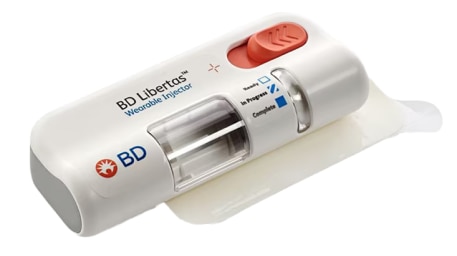
BD LibertasTM Wearable Injector**
Enabling high-volume subcutaneous delivery
As biologic therapies evolve toward higher doses and less frequent administration, large volume and high-viscosity formulations for subcutaneous delivery are being explored as an alternative to intravenous infusion.4,5
BD LibertasTM Injector is a drug delivery technology evaluated through preclinical and clinical studies, including a clinical evaluation of a 5 mL delivery system configuration.9
Clinical evaluation has demonstrated that large-volume subcutaneous delivery using the BD LibertasTM Wearable Injector is feasible and acceptable. BD LibertasTM Wearable Injector is a product in development, with forward looking statements applying.9
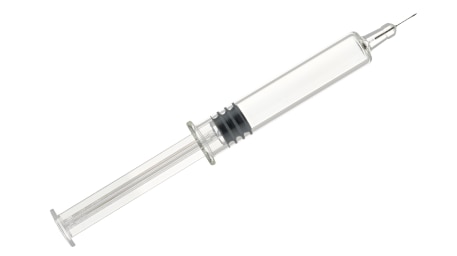
BD NeopakTM XtraFlowTM Glass Prefillable Syringe
Optimizing injectability for high viscosity formulations
High viscosity biologics can increase injection force and prolong injection time, impacting delivery performance and patient experience.4
BD NeopakTM XtraFlowTM optimizes injectability by combining shorter needle length with thinner wall cannula designs, increasing inner diameter while maintaining standard gauge profiles. System level evaluations have shown improvements in injection time and delivery performance under high viscosity conditions. This combination offers a solution to balance injection force, time, and viscosity requirements without requiring patient experience trade-offs.4
Building on this platform, BD is also developing a 5.5 mL BD NeopakTM XtraFlowTM Glass Prefillable Syringe designed to support higher volume biologic delivery while maintaining compatibility with established autoinjector platforms.10
BD iDFill™ Individual Prefillable Syringe Identification
Advancing unit-level traceability in fill & finish operations

Why traceability - and why now?
Traceability solutions enable identification and tracking of individual primary containers, supporting compliance and operational control in manufacturing environments.11 Regulatory expectations and operational constraints are driving the need for improved traceability across fill & finish environments.11,12
Unit-level traceability enables the unique identification of each individual primary container. This capability supports improved operational visibility and enhanced compliance frameworks.11

Technology readiness and feasibility
Unit-level traceability using RFID technology has been demonstrated to be technically feasible and compatible with GMP manufacturing environments.11
Each container can be assigned a Container Unique Identifier (CUID), enabling non-line-of-sight tracking throughout manufacturing - from filling to packaging - without disrupting existing operations.11
Demonstrations in GMP environments have confirmed compatibility with manufacturing processes, as well as scalability and operator acceptance.11

Proven operational benefits
Implementation of unit-level traceability has demonstrated reductions in manual documentation effort while maintaining performance during critical steps such as visual inspection.11
Additional benefits include:
- Automated reconciliation
- Improved mix-up prevention
- Faster root cause investigation
- Segregation of impacted units
These capabilities contribute to improved process control and reduced operational risk.11
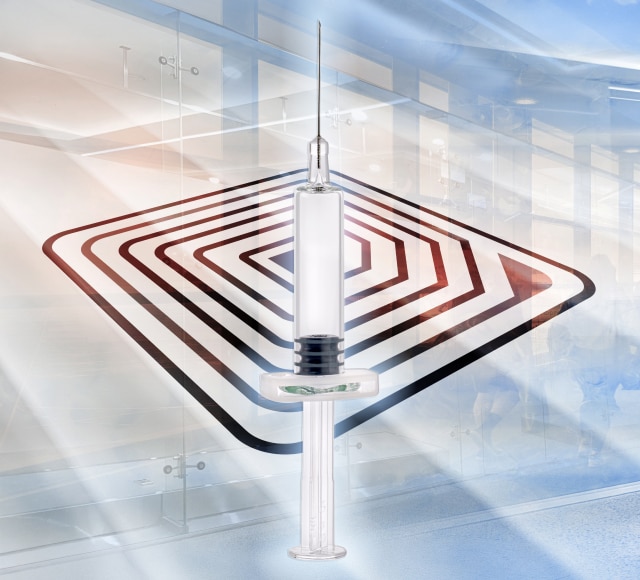
Enabling Digital Transformation in Pharmaceutical Manufacturing
Unit-level traceability enables data capture at the individual container level, supporting process monitoring and continuous improvement strategies aligned with Industry 4.0 principles applied to pharmaceutical manufacturing.11
As part of BD innovation approach, BD iDFill" illustrates how primary container technologies can support more connected and data-driven manufacturing environments.11
Innovating stoppers and closure systems as part of the complete delivery system
As delivery strategies evolve, it becomes increasingly clear that injectable drug performance cannot be assessed component by component. Drug quality, delivery consistency, and patient safety are governed by how the glass container, elastomeric closure, lubrication, and device interface function together as a system.
With biologic formulations becoming more sensitive and regulatory expectations continuing to evolve, biopharmaceutical developers increasingly require system level evidence-not assumptions-to support design decisions and risk assessments.
A customer challenge driven by system interactions
Common challenges related to stopper and closure systems include:
-

Maintaining container closure integrity (CCI) across storage, transport, and use conditions
-

Managing interactions between elastomeric closures and biologic formulations, including risks associated with silicone and extractables
-

Ensuring consistent gliding behavior and functional performance when integrated into combination products
-

Demonstrating compliance with regulatory and pharmacopeial expectations that focus on complete systems rather than isolated components
These challenges cannot be resolved by optimizing individual components in isolation14.
BD innovation approach: stoppers as system enablers
At BD Pharmaceutical Systems, stoppers and closure systems are developed as cross cutting system enablers, not discrete components. This system level approach focuses on:
-

Designing stopper barrel interfaces to support predictable CCI within the assembled system
-

Controlling silicone behavior as a contributor to both functional performance and formulation compatibility
-

Evaluating elastomeric closures within fully assembled systems, including prefillable syringes and autoinjectors
-

Supporting industrial robustness, including compatibility with high speed fill finish and inspection processes
Within this approach, BD combines advanced elastomeric closure solutions such as BD SCFTM PremiumCoat® plunger stoppers with prefillable syringe platforms, including BD NeopakTM XtraFlowTM, to support consistent gliding performance, container closure integrity, and overall system reliability in combination products.
By addressing stopper performance within real world system contexts, BD helps customers reduce variability and anticipate performance across the product lifecycle.14
BD also collaborates with strategic partners, as well as pharmaceutical stakeholders, to support the co-development and integration of drug device solutions that expand combination product design space while maintaining compatibility with established platforms and manufacturing processes.
BD collaborates with device partners such as Ypsomed to support integration of BD prefillable syringe platforms with autoinjector technologies, particularly in the context of high-viscosity and large-volume drug delivery.4
BD also collaborates with SHL Medical to support the integration of drug delivery systems into combination product configurations.13
System level evidence, not assumptions
Regulatory frameworks increasingly emphasize a holistic evaluation of container closure integrity and system performance in combination products, rather than reliance on single-component compliance alone14.

Via ZebraSci A BD Company expert in combination product testing, BD supports this approach by generating system-level data that considers:
-

Siliconization profiles and their impact on drug compatibility and system performance12,15
-

Deterministic CCI testing methods aligned with USP <1207>, replacing probabilistic approaches14
-

Functional metrics such as break-loose and glide forces within assembled systems14
-

The influence of primary container materials and components including elastomers) on drug interaction risk and extractables/leachables profiles and associated toxicological risk assessment12,15
Applying innovation through system expertise and collaboration

Innovation creates value only when it can be translated into manufacturable, compliant, and scalable solutions. BD Pharmaceutical Systems supports this translation through a solution oriented model that integrates system expertise, testing, regulatory understanding, and collaborative development.
Across emerging, in development, and externally communicated innovations, BD consistently focuses on the complete drug container device system, enabling informed development decisions supported by evidence rather than assumptions.
By combining system level testing, regulatory aligned risk mitigation, manufacturing integration expertise, and collaborative partnerships, BD helps biopharmaceutical customers responsibly apply innovation across the product lifecycle.
Explore our products
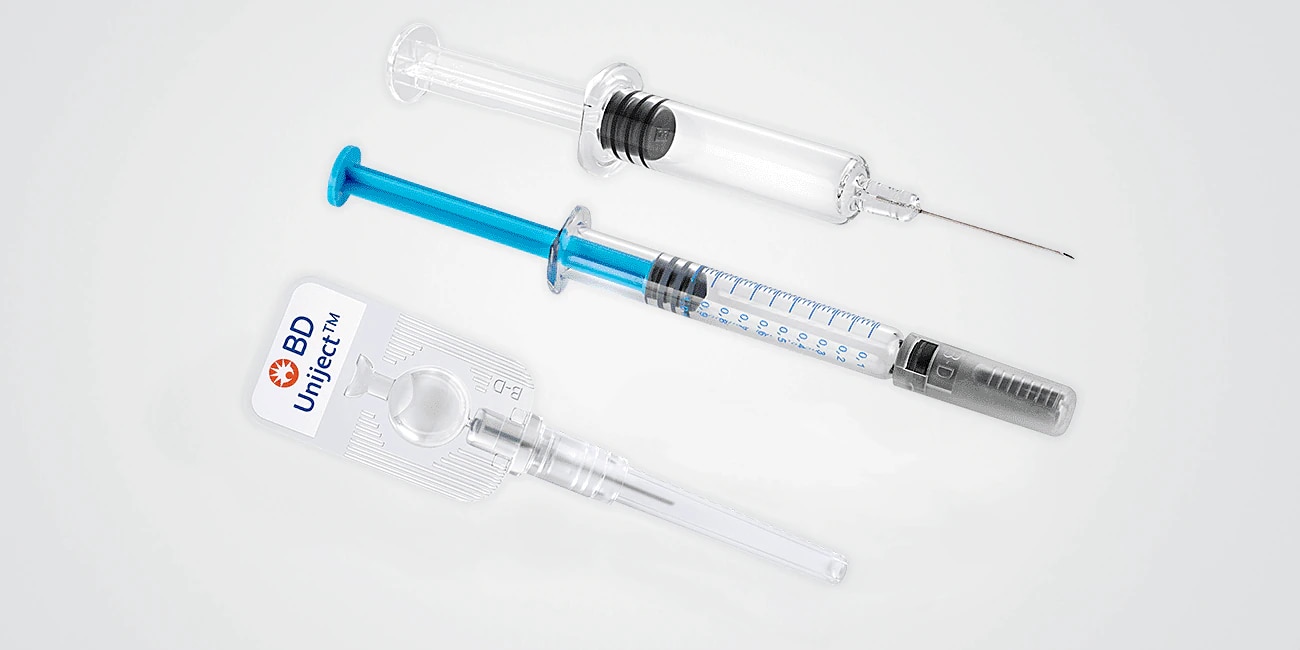
Prefillable syringe systems
BD is uniquely positioned to offer prefillable syringe systems with expertise in drug container interactions, primary container selection and container/device integration for various drug therapies.
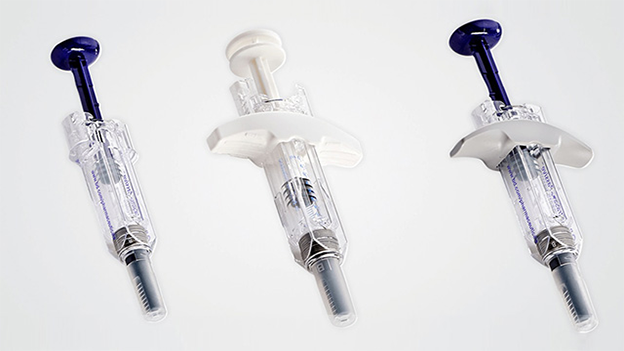
Safety and shielding systems
BD offers a wide range of safety and shielding systems that feature innovative needle shielding system technology for your injectable drug.
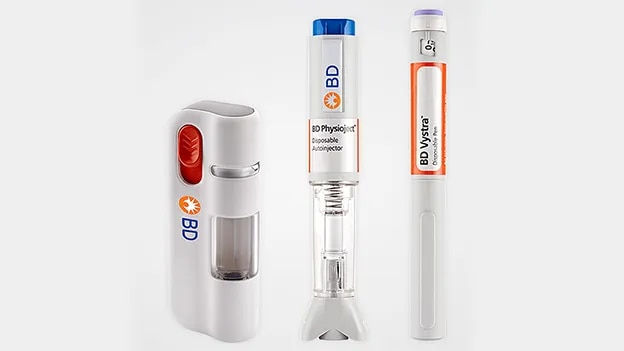
Self injection systems
BD partners with you to develop self injection systems that enable drug administration across a range of volumes and viscosities, leveraging BD primary container technologies and expertise with a focus on reaching the market faster.
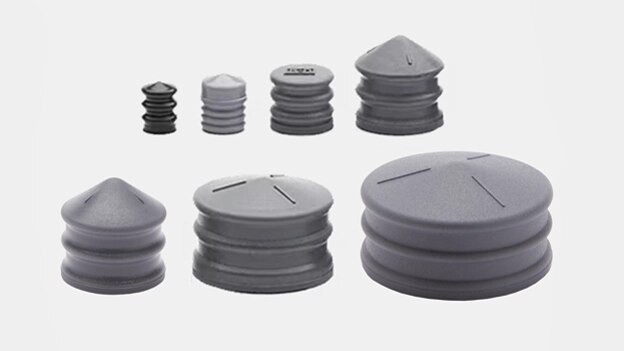
Plunger Stoppers
With our two stopper processing sites, we aim to offer security of supply and business continuity for your drug combination product needs.
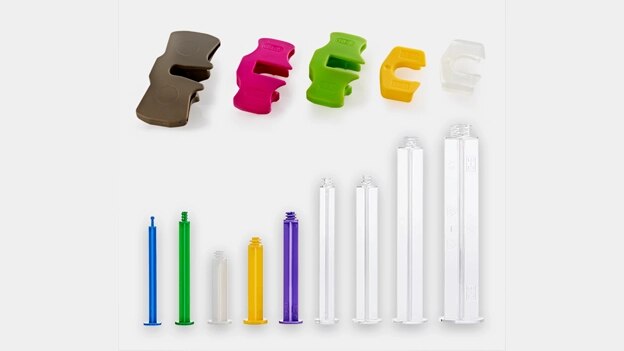
Backstops and plunger rods
As part of our integrated approach to help you develop drug combination products, we offer BD Backstops and BD Plunger Rods in a range of sizes, materials and colors.
Prefillable syringe systems
Safety and shielding systems
Self injection systems
Plunger Stoppers
Backstops and plunger rods
* The BD dual-injection valve and syringe system is a product in development. Some statements made are forward-looking and are subject to a variety of risks and uncertainties..
** BD Libertas™ Wearable Injector is a product in development; some statements are forward looking and are subject to a variety of risks and uncertainties. BD Libertas™ Wearable Injector is a device component intended for drug-device combination products and not subject to FDA 510(k) clearance or separate EU CE mark certification.
- Chauhan, V.M. et al. (2020). Advancements in the co-formulation of biologic therapeutics. Journal of Controlled Release, 327, pp.397–405. Veeva ID: BD-162330.
- Mueller, C., Altenburger, U. & Mohl, S. (2018). Challenges for the pharmaceutical technical development of protein co-formulations. Journal of Pharmacy and Pharmacology, 70(5), pp.666–674. Veeva ID: BD-162330.
- Flippe, M. & Lelias, S. (2025). Reimagining dual-chamber injection: de-risking a novel valve component for use with standard syringe systems. ONdrugDelivery, Issue 177. Veeva ID: BD-162330.
- Blaser, T. & Douaire, M. (2025). Optimising high-dose delivery: syringe–autoinjector integration, injection time and performance. ONdrugDelivery, Issue 172, pp.32–37. Veeva ID: BD-170928.
- Lorenz, B. & Persson, B.N.J. (2010). Leak rate of seals: Effective-medium theory and comparison with experiment. European Physical Journal E, 31, pp.159–167. Veeva ID: BD-162330.
- Depaz, E. et al. (2014). Cross-linked silicone coating: a novel prefilled syringe technology that reduces subvisible particles and maintains compatibility with biologics. Journal of Pharmaceutical Sciences, 103, pp.1384–1393. Veeva ID: BD-36243.
- Felsovalyi, F. et al. (2012). Silicone oil-based subvisible particles: formation, detection, and impact on biologics. Veeva ID: BD-15352.
- United States Pharmacopeia (USP) (current edition). <788> Particulate Matter in Injections. Veeva ID: BD-15352.
- Woodley, W.D. et al. (2021). Clinical evaluation of an investigational 5 mL wearable injector in healthy human subjects. Clinical and Translational Science, 14(3), pp.859–869. Veeva ID: BD-155087.
- Yadav, J. et al. (2025). Developing ultra-high concentration formulations of human immune globulins for subcutaneous injectables. Journal of Pharmaceutical Sciences, 114(3), pp.1605–1614. Veeva ID: BD-147731.
- International Society for Pharmaceutical Engineering (ISPE) (2021). Unique identification of primary containers to drive product traceability and quality. ISPE Discussion Paper. Veeva ID: BD-136055.
- U.S. Food and Drug Administration (FDA) (2024). Quality Management Maturity: Essential for Stable U.S. Pharmaceutical Supply Chains. FDA. Veeva ID: BD-136055.
- Schneider, A. et al. (2019). Hold the device against the skin: the impact of injection duration on user’s force for handheld autoinjectors. Expert Opinion on Drug Delivery, 17(2), pp.225–236. Veeva ID: BD-147731.
- United States Pharmacopeia (USP) (current edition). <382> Elastomeric components in injectable drug products. Veeva ID: BD-166896.
- Singh, S.K. et al. (2011). Impact of product-related factors on immunogenicity of biotherapeutics. Journal of Pharmaceutical Sciences. Veeva ID: BD-15352.
