true

Venovo™ Venous Stent System

Purpose-Built for the Iliofemoral Veins 


header-image-small-copy.png
Contact Us
Loading

Overview

Venous disease is complex — your stent choice doesn't have to be

  • Engineered to provide the optimal balance between radial force, flexibility and compression resistance
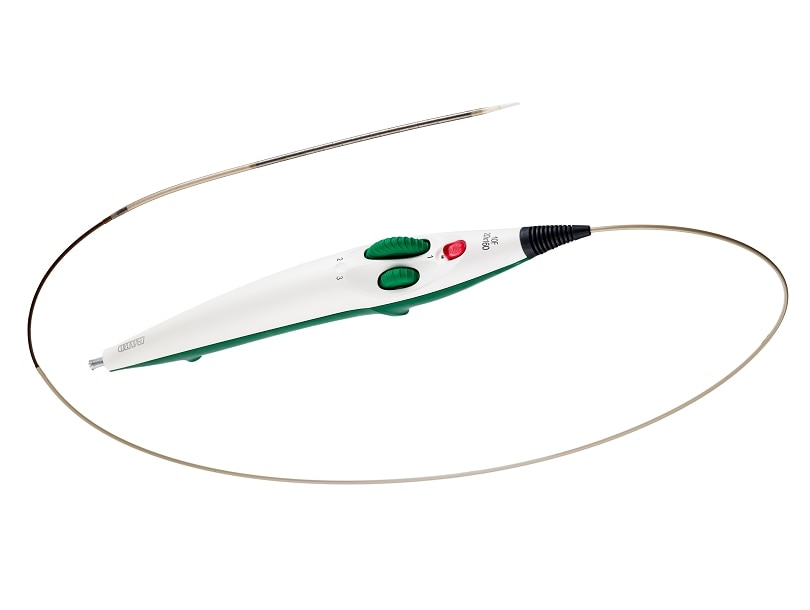
  • Tri-axial delivery system designed to provide accurate deployment to help facilitate optimal stent placement and lesion coverage
  • 3 mm flared stent ends designed to reduce the risk of stent migration and maximize wall apposition
  • Broadest size matrix of iliofemoral-indicated venous stents in the U.S.1
    • Diameters up to 20 mm
    • Stent lengths up to 160 mm


Overview and Procedure

Purpose-Built Iliofemoral Venous Stent

  • Flared ends designed to reduce stent migration and maximize wall apposition
  • Designed for use in high compression iliofemoral venous obstructions
  • Open-cell, flexible design to conform to vessel curvature while maintaining lumen diameter
  • Highest mean radial resistive force among tested iliofemoral venous stents2
  • Tantalum markers for enhanced visibility under fluoroscopy
  • Minimal foreshortening for maximum lesion coverage3


Placement Accuracy


Triaxial delivery system designed for:

  • Ease of use
  • Deployment control
  • Precise placement accuracy    
  • Operator control with an ergonomic handle and dual-speed thumbwheels

Full Range of Sizes

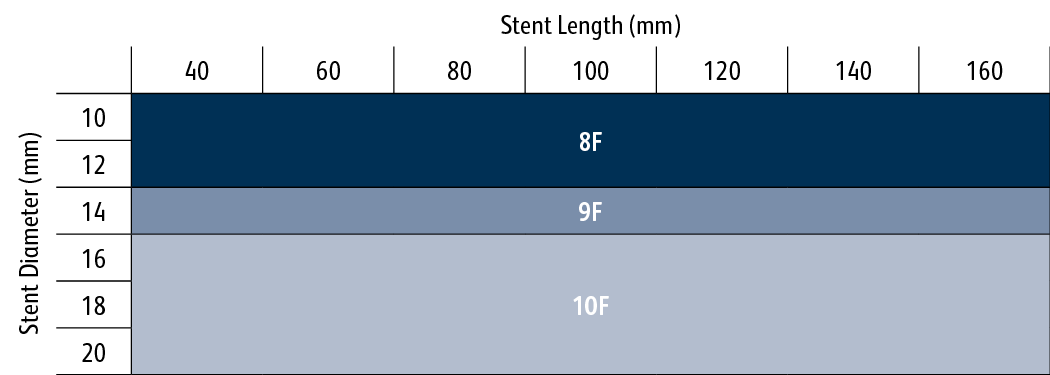
The Venovo™ Venous Stent offers a broad selection of 42 sizing options in both 80 cm and 120 cm catheter lengths to accommodate a variety of iliofemoral lesion sizes.

Contact Us
References
  1.  As of September 2025
  2. Radial resistive force was tested at 13 mm crimp diameter (1 mm oversizing) using a radial expansion force gauge. Results shown as averages measured in N/mm as follows (n=6): Venovo™ Venous Stent System (0.126), Medtronic Abre™ Venous Stent (0.1035), Cook Zilver® Vena™ (0.063) and Boston Scientific VICI VENOUS STENT® (0.054). Bench tests may not be indicative of clinical performance. Different test methods may yield different results. Data on file, BD, Tempe, AZ.
  3. Foreshortening is calculated as the difference, represented as percentage, between the compressed stent length and expanded stent length at minimum/maximum oversize (1-3 mm). Across all sizes, foreshortening ranged from -4% to 10%, with a mean of 2.9% (values based on mathematical calculations). Bench tests may not be indicative of clinical performance. Different test methods may yield different results. Data on file, BD, Tempe, AZ.

Please consult Instructions for Use for product indications for use, contraindications, warnings, precautions, potential complications, adverse events and detailed safety information.

Venovo IFU

BD - 23533v4

Products & Accessories
Sort by:
References

Please consult Instructions for Use for product indications for use, contraindications, warnings, precautions, potential complications, adverse events and detailed safety information.

Overview

Help Prevent Stent Migration with Flared Ends

The Venovo™ Venous Stent is the ONLY venous stent engineered with flared ends.*

Watch the video below to see the flared ends in action!

Why Flared Ends?

BD_BARD_Venovo-stent.png

The flared ends on the Venovo™ Venous Stent were intentionally designed for two reasons:


  1. To maximize wall apposition
  2. To help prevent stent migration

Comparative Bench Testing

The Venovo™ Venous Stent had the highest mean pull-out force, interpreted as migration resistance, among tested iliofemoral venous stents in simulated use testing.2,3

References

*as of September 2025

The Venovo™ Venous Stent System was studied in the global VERNACULAR clinical trial, which was a prospective, multi-center, non-randomized, single-arm study of 170 patients. The primary effectiveness endpoint of the study was primary patency (PP) at 12 months post-index procedure, defined as: freedom from target vessel revascularization and freedom from thrombus occlusion and stenosis > 50% as measured by diagnostic ultrasound. Patients who received a Venovo™ Venous Stent had a weighted 12-month PP rate of 88.6%, demonstrating a statistically significant difference from a literature-derived performance goal (PG) of 74%. The primary safety endpoint was freedom from major adverse events (MAE) through 30 days post-index procedure. Freedom from MAE through 30 days was 93.5%, demonstrating a statistically significant difference from a literature-derived PG of 89%. There were no stent migrations associated with CEC-adjudicated events at the 30-day primary safety endpoint or through 36 months. Dake MD, O’Sullivan G, Shammas NW, et al. Three-year results from the Venovo venous stent study for the treatment of iliac and femoral vein obstruction. Cardiovasc Intervent Radiol. 2021;44(12):1918-1929. doi: 10.1007/s00270-021-02975-2

Simulated use data on file. BD, Tempe, AZ. Results may not be predictive of actual clinical outcomes. Different test methods may yield different results. Venovo™ Stent (14 mm x 100 mm, N=6), Medtronic Abre™ Stent (14 mm x 100 mm, N=6). The maximum pull-out force of an implant from a silicone tubing section at 1 mm oversizing and at an overlap length of 40 mm was measured. A higher pull-out force is interpreted as higher migration resistance. Venovo™ Stent demonstrated higher mean pull-out force (0.107 N/mm) compared to the Medtronic Abre™ Stent (0.095 N/mm).

Simulated use data on file. BD, Tempe, AZ. Results may not be predictive of actual clinical outcomes. Different test methods may yield different results. Venovo™ Stent (14 mm x 100 mm, N=6), Cook Zilver® Vena™ Stent (14 mm x 100 mm, N=6). The pull-out force of an implant from a silicone tubing section at the recommended minimum oversizing and at a defined overlap length was measured. A higher pull-out force is interpreted as higher migration resistance. Venovo™ Stent demonstrated higher mean pull-out force (0.110 N/mm) compared to the Cook Zilver® Vena™ Stent (0.038 N/mm).


BD - 23533v4

Clinical Summary

Proven Long-Term Results Backed by 36-Month Data1

The VERNACULAR study results provide scientific evidence that the Venovo™ Venous Stent System is safe and effective for the treatment of symptomatic iliofemoral venous
outflow obstruction.


  • 748-final_resized.png

    Kaplan-Meier Primary Patency in Post-Thrombotic Lesions at 36 months

  • 955 final_resized.png

    Kaplan-Meier Primary Patency in Non-Thrombotic Lesions at 36 months

  • 881-final_resized.png

    Freedom from Target Lesion Revascularization (TLR) at 36 months

  • 0-final_resized.png

    Stent Fractures at 36 months

VERNACULAR Clinical Study1

Study Design

Prospective, multi-center, non-randomized, single-arm; Core lab & Data Safety Monitoring Board


Purpose

To assess the safety and effectiveness of the Venovo™ Venous Stent
for the treatment of iliofemoral venous occlusive disease.

As Treated Population

170 subjects at 21 sites in the U.S., Europe, and Australia/New Zealand

Primary Endpoints*

  • Primary safety: Freedom from Major Adverse Events (MAE), including stent migrations, at 30 days


  • Primary Effectiveness: Primary Patency at 12 months
    • Weighted Primary Patency at 12-Months: 88.6%
      • Post-Thrombotic Syndrome (PTS): 81.7%
      • Non-Thrombotic Iliac Vein Lesion (NIVL): 97.1%


 Key Secondary Endpoints

  • Placement accuracy: 100%
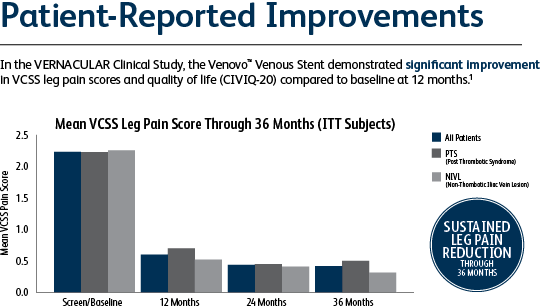
  • Venous Clinical Severity Score (VCSS) through 36 months


36-Month Results

(Kaplan-Meier estimated Primary Patency)

Primary Patency: 84.0%

  • PTS: 74.8%
  • NIVL: 95.5%


* Evaluated against literature derived performance goal of 74% for efficacy (p<.0001) and 89% for safety (p=.032)

Significant Improvements

Reference

  1. The Venovo™ Venous Stent System was studied in the global VERNACULAR clinical trial, which was a prospective, multi-center, non-randomized, single-arm study of 170 patients. The primary effectiveness endpoint of the study was primary patency (PP) at 12 months post-index procedure, defined as: freedom from TVR and freedom from thrombus occlusion and stenosis > 50% as measured by DUS. Patients who received a Venovo™ Venous Stent had a weighted PP rate of 88.6%, demonstrating a statistically significant difference from a literature-derived performance goal (PG) of 74%, with an 81.7% PP rate for subjects with post-thrombotic syndrome and 97.1% PP rate for subjects with non-thrombotic iliac vein lesions. The primary safety endpoint was freedom from major adverse events (MAE) through 30 days post-index procedure. Freedom from MAE was 93.5%, demonstrating a statistically significant difference from a literature-derived PG of 89%. There were no stent migrations associated with CEC-adjudicated events at the 30-day primary safety endpoint or through 36 months. Primary Patency by Kaplan-Meier estimates at 36 months are 84.0% for the total population (N=170), 74.8% for subjects with post-thrombotic syndrome (N=93) and 95.5% for subjects with non-thrombotic iliac vein lesions. Secondary endpoints included acute technical success, Quality of Life (QoL) assessment, Venous Clinical Severity Score (VCSS – Pain score) and stent fractures. Results demonstrated 100% acute technical success, defined as successful deployment of stent(s) to intended target with adequate lesion coverage as assessed by the Investigator at the time of the index procedure. TLR is defined as the first revascularization procedure in the target vessel(s) following the index procedure, as determined by an Independent Core Lab. The Freedom from TLR rate at 36 months was 88.1%. At the 36-month follow-up, the CIVIQ-20 assessment demonstrated a change from baseline in the total study population of -16.8 and, for the VCSS Pain score, a change from baseline in the total population of -1.8. Stents were evaluated at the 36-month follow-up for fracture analysis. An anteroposterior and lateral x-ray for each evaluated stent were sent to an independent core lab for analysis. 98 subjects’ x-rays were analyzed and no stent fractures were reported. Missing x-ray analyses were recorded as protocol deviations. Dake MD, O'Sullivan G, Shammas NW, et al. Three-year results from the Venovo Venous Stent study for the treatment of iliac and femoral vein obstruction. Cardiovasc Intervent Radiol. 2021;44(12):1918-1929. doi: 10.1007/s00270-021-02975-2

Please consult Instructions for Use for product indications for use, contraindications, warnings, precautions, potential complications, adverse events and detailed safety information.

BD - 23533v4

Resources

Reference

Please consult Instructions for Use for product indications for use, contraindications, warnings, precautions, potential complications, adverse events and detailed safety information.

Venovo™ Venous Stent System BD Venovo™ Venous Stent System /content/dam/bd-assets/bd-com/en-us/logos/bd/header-bd-logo.svg

Purpose-Built for the Iliofemoral Veins 


venum20160 Venovo™ Venous Stent System venum20140 Venovo™ Venous Stent System venum20120 Venovo™ Venous Stent System venum20100 Venovo™ Venous Stent System venum20080 Venovo™ Venous Stent System venum20060 Venovo™ Venous Stent System venum20040 Venovo™ Venous Stent System venum18160 Venovo™ Venous Stent System venum18140 Venovo™ Venous Stent System venum18120 Venovo™ Venous Stent System venum18100 Venovo™ Venous Stent System venum18080 Venovo™ Venous Stent System venum18060 Venovo™ Venous Stent System venum18040 Venovo™ Venous Stent System venum16160 Venovo™ Venous Stent System venum16140 Venovo™ Venous Stent System venum16120 Venovo™ Venous Stent System venum16100 Venovo™ Venous Stent System venum16080 Venovo™ Venous Stent System venum16060 Venovo™ Venous Stent System venum16040 Venovo™ Venous Stent System venum14160 Venovo™ Venous Stent System venum14140 Venovo™ Venous Stent System venum14120 Venovo™ Venous Stent System venum14100 Venovo™ Venous Stent System venum14080 Venovo™ Venous Stent System venum14060 Venovo™ Venous Stent System venum14040 Venovo™ Venous Stent System venum12160 Venovo™ Venous Stent System venum12140 Venovo™ Venous Stent System venum12120 Venovo™ Venous Stent System venum12100 Venovo™ Venous Stent System venum12080 Venovo™ Venous Stent System venum12060 Venovo™ Venous Stent System venum12040 Venovo™ Venous Stent System venum10160 Venovo™ Venous Stent System venum10140 Venovo™ Venous Stent System venum10120 Venovo™ Venous Stent System venum10100 Venovo™ Venous Stent System venum10080 Venovo™ Venous Stent System venum10060 Venovo™ Venous Stent System venum10040 Venovo™ Venous Stent System venul20160 Venovo™ Venous Stent System venul20140 Venovo™ Venous Stent System venul20120 Venovo™ Venous Stent System venul20100 Venovo™ Venous Stent System venul20080 Venovo™ Venous Stent System venul20060 Venovo™ Venous Stent System venul20040 Venovo™ Venous Stent System venul18160 Venovo™ Venous Stent System venul18140 Venovo™ Venous Stent System venul18120 Venovo™ Venous Stent System venul18100 Venovo™ Venous Stent System venul18080 Venovo™ Venous Stent System venul18060 Venovo™ Venous Stent System venul18040 Venovo™ Venous Stent System venul16160 Venovo™ Venous Stent System venul16140 Venovo™ Venous Stent System venul16120 Venovo™ Venous Stent System venul16100 Venovo™ Venous Stent System venul16080 Venovo™ Venous Stent System venul16060 Venovo™ Venous Stent System venul16040 Venovo™ Venous Stent System venul14160 Venovo™ Venous Stent System venul14140 Venovo™ Venous Stent System venul14120 Venovo™ Venous Stent System venul14100 Venovo™ Venous Stent System venul14080 Venovo™ Venous Stent System venul14060 Venovo™ Venous Stent System venul14040 Venovo™ Venous Stent System venul12160 Venovo™ Venous Stent System venul12140 Venovo™ Venous Stent System venul12120 Venovo™ Venous Stent System venul12100 Venovo™ Venous Stent System venul12080 Venovo™ Venous Stent System venul12060 Venovo™ Venous Stent System venul12040 Venovo™ Venous Stent System venul10160 Venovo™ Venous Stent System venul10140 Venovo™ Venous Stent System venul10120 Venovo™ Venous Stent System venul10100 Venovo™ Venous Stent System venul10080 Venovo™ Venous Stent System venul10060 Venovo™ Venous Stent System venul10040 Venovo™ Venous Stent System
Venovo, Venous Stent, iliac vein, femoral vein,vernacular